Most guides tell you digital products are easy passive income. Here’s the truth, and the shortcut that changes everything.
Stop me if this sounds familiar.
You read an article about selling digital products.
It makes everything sound effortless.
Create an ebook. Upload it to Etsy. Watch the money roll in while you sleep.
So you spend three weeks building something. You upload it. You wait.
Nothing…
That’s the experience most beginners have, not because the model is broken, but because nobody told them the part that actually matters:
The product is not the hard part. Getting it in front of people who want to buy it is.
Before we go any further, if you want to see exactly how people are using AI and Instagram to solve the traffic problem and start generating real digital product income from scratch, my mentor Richard Yu is running a free live masterclass that shows you the whole system.
No guessing. No months of trial and error. Just a clear, working playbook, taught live, for free.
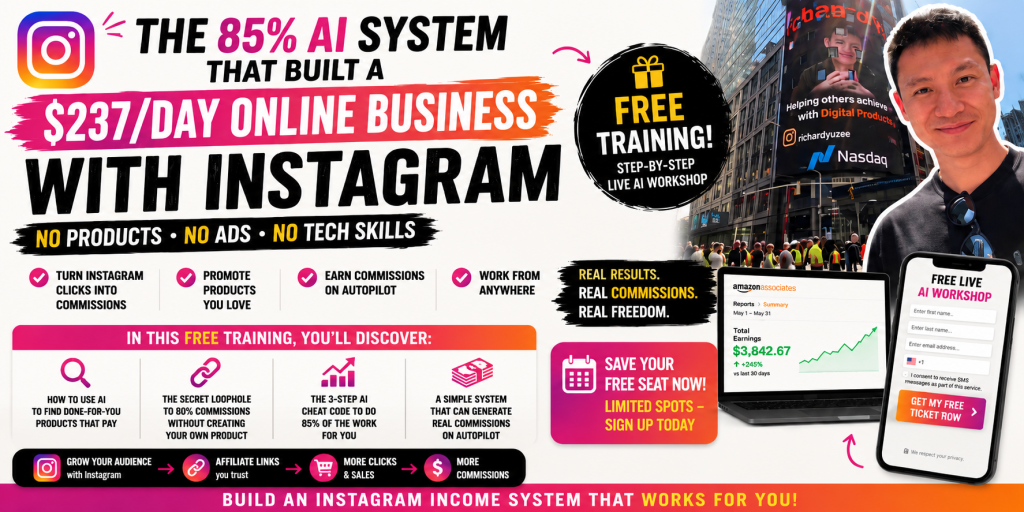
Grab your spot, then keep reading. Because what follows is the honest beginner’s guide that most websites are too afraid to publish.
First, the Truth About Digital Products
Digital products are genuinely one of the best income models available to beginners in 2026.
No inventory. No shipping. No restocking. You create something once and sell it indefinitely; every sale is nearly pure profit.
But here’s what the glossy success stories leave out:
- Most creators spend one to three months earning nothing before their first meaningful sale.
- Products don’t sell themselves.
- Marketplaces like Etsy and Udemy are flooded with competition.
- And “passive income” is a long-term destination, not a starting point.
The people who break through are not the ones who build the best product.
They’re the ones who solve the traffic problem first, and in 2026, AI has made that more achievable for beginners than at any point in history.
With that context in mind, here’s exactly how to do this right.
Step 1: Choose a Niche That Has Proven Buyers

The single most common beginner mistake is choosing a product based on what they enjoy making rather than what people are already spending money on.
The fastest path is to look for existing demand and fill it better.
- Browse top sellers on Etsy and Gumroad.
- Read the reviews, the complaints and wish lists in those reviews are your product roadmap.
- Search your topic on Pinterest and Google and watch what autocomplete suggests.
Those suggestions are real searches from real people with real money.
The niches that consistently convert for digital product beginners:
- budget and finance templates
- meal planning tools
- social media content kits
- productivity planners
- business starter guides
- and niche-specific educational ebooks.
The rule: solve one specific problem for one specific person.
Not “a planner for women.” A planner for freelance moms managing client projects and school pickups on the same calendar.
Step 2: Build a Lean First Product, Not a Perfect One

Your first product should take days to build, not months.
A lean, clear, useful product that solves one problem will outperform an elaborate product that took three months to create and has no audience waiting for it.
Buyers care about outcomes, not aesthetics.
They want to know:
will this save me time, make me money, solve my problem, or teach me something?
Answer that clearly and the product sells. Overdesign it without an audience and nothing changes.
Tools like Canva, Google Docs, and Notion let you build professional-looking templates, ebooks, and guides without any design background.
AI tools help you write the content, structure the guide, and generate the product descriptions, cutting production time by 80% for most beginners.
Build it in a week. Get it live. Get feedback. Improve it.
That cycle is worth more than six months of perfecting something nobody has seen yet.
Step 3: Pick the Right Platform for Where You Are Right Now

This decision trips up more beginners than almost anything else, so here’s a simple framework:
No audience yet?
Start on a marketplace like Etsy or Creative Market.
You get access to built-in traffic while you build your own following.
The downside is competition and commission fees, but it’s the fastest way to validate that people will actually pay for what you’re selling.
Building an audience?
Use a creator platform like Gumroad or Payhip.
These give you a simple storefront to link to from your social media, email list, or blog.
You drive the traffic, they handle the delivery and payment.
Ready to build a real business?
Move to your own store. Full control, full branding, full ownership of your customer list.
This is the goal, but it works best once you already have traffic coming in.
Most successful digital product sellers start on marketplaces, build their audience through content, and eventually migrate to their own platform.
You don’t have to choose one forever. Start where you are.
Step 4: Price With Confidence, Not Apology

Most beginners underprice because they’re not sure anyone will buy.
This is backwards psychology.
Low prices don’t attract more buyers in the digital product space, they attract skepticism.
A $7 ebook feels disposable. A $37 ebook feels like an investment worth opening.
Start by looking at what comparable products sell for and positioning in the middle to upper range.
If your product genuinely solves the problem it promises to solve, it earns its price.
You can always test and adjust, but start with confidence, not a clearance sale mentality.
Step 5: Solve the Traffic Problem (This Is Everything)

Here’s the part every other beginner guide glosses over: you can have the best digital product in your niche and earn nothing if nobody sees it.
Traffic is the business. Everything else is preparation.
The creators earning consistent digital product income in 2026 are not necessarily the ones with the best products.
They’re the ones who figured out content marketing, specifically how to use platforms like Instagram and Pinterest to put their products in front of people who are actively looking to buy.
And AI has completely changed what this takes.
Content that used to require hours of writing, designing, and planning can now be produced in under an hour with the right workflow.
Captions, hooks, email sequences, product descriptions, Pinterest pin copy: AI drafts it, you refine it, the algorithm distributes it.
This is the actual skill that separates people who dabble in digital products from people who build real income from them.
The Shortcut That Compresses Months Into Weeks

The gap between “I uploaded my first product” and “I’m making consistent sales” is almost always a traffic and marketing knowledge gap. Not a product quality gap.
Richard Yu has built a system that combines AI content creation with Instagram marketing specifically to solve this problem for beginners, and he teaches it live, completely free, to people who are ready to take action.
In his free masterclass, you’ll see exactly how to use AI to create the content that drives buyers to your products, which Instagram strategies work for small accounts with no prior following, and how to set up a system that runs largely on autopilot once it’s built.
This is the information that most people spend 6 to 12 months figuring out through expensive trial and error.
Richard hands it to you in a single live session.
The product is the easy part. The system is what pays you.
👉 Claim your free seat at Richard’s live masterclass HERE
Register now. Show up live. Ask your specific questions. Walk away with a roadmap that actually works.
Because the truth about digital products isn’t that they’re hard. It’s that nobody shows you the complete picture until now.
This post contains affiliate links. I may earn a commission at no extra cost to you.
Leave a Reply