The honest guide to building a digital product income stream, and the AI-powered shortcut that makes the whole thing dramatically faster.
Here’s a scenario that plays out thousands of times every day.
Someone reads an inspiring article about passive income from digital products.
They spend six weeks building an ebook. They upload it to Etsy, share it once on Instagram, and wait…
Nothing happens.
So they assume digital products don’t work for people like them, when the real problem was never the product.
It was the system around the product that was missing.
The people quietly earning consistent passive income from digital products aren’t necessarily creating better products than you would.
They’re simply operating a better system. And in 2026, AI has made that system more buildable, more accessible, and faster to set up than at any point in the history of online business.
If you want to see exactly how that system works.
From product selection to AI-powered marketing to Instagram distribution, my mentor Richard Yu breaks down the entire framework in a free masterclass built for complete beginners.
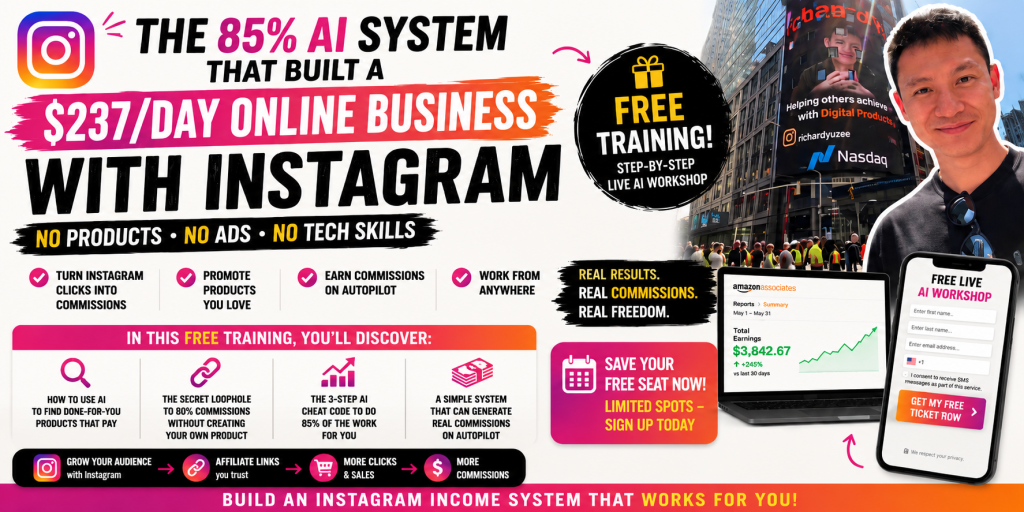
👉 Access the free masterclass HERE
Grab your spot now, then keep reading, because what follows is the honest, practical guide to selling digital products that most articles are too afraid to publish.
Why Most Digital Product Advice Sets You Up to Fail
The standard advice follows a predictable script:
- Find your passion
- Create an ebook or course
- Put it on Etsy
- & watch the passive income roll in.
What that advice skips is the part that actually determines success:
Traffic, trust, and a conversion system that works without you being present for every sale.
A digital product sitting in an Etsy shop with no traffic is just a file on a server.
The product isn’t the business.
The system that consistently puts that product in front of people who want to buy it… that’s the business!
Most beginners spend all their time on the product and almost no time on the system. Then they wonder why nothing sells.
Here’s the framework that actually works.
Step 1: Validate Before You Build

The single most common reason digital products fail is that they were built in isolation, created based on what the seller wanted to make rather than what buyers are actively searching for.
Validation doesn’t require a survey or months of market research.
It requires 30 minutes of honest investigation.
Go to Etsy and search your product idea. Filter by bestsellers.
If there are dozens of products in your category with hundreds of sales and reviews…
Congratulations, you’ve found a validated market.
People are already spending money here. Your job is to create a version that’s slightly better, more specific, or better presented than what’s already selling.
If you can’t find anyone selling what you want to create, that’s not an untapped niche.
That’s usually a signal that nobody wants to buy it.
Do the research first. Build second.
Step 2: Build a Lean Product Fast (Then Improve It)
The most dangerous trap in digital product creation is perfectionism. Weeks become months. Months become never.
Your first product should solve one specific problem for one specific type of person, and it should take days to build, not months.
A 15-page focused guide that solves a real problem sells better than a 90-page comprehensive resource that took three months to write and arrived too late to maintain momentum.
AI has eliminated the biggest bottleneck in product creation: the writing.
Use it to outline your product, draft the content, write the product description, and generate the promotional copy.
What used to require significant writing skill and time now takes an afternoon with the right prompts.
Build it lean. Get it live. Let real sales data tell you what to improve.
Step 3: Choose the Right Platform for Your Stage

Platform choice trips up more beginners than almost any other decision.
Here’s the simple rule: match your platform to where you actually are, not where you want to be.
No audience yet:
Start on a marketplace like Etsy or Gumroad where built-in search traffic gives you visibility before you’ve built your own following.
The trade-off is fees and competition, but the speed to your first sale is dramatically faster.
Growing audience:
Use a simple creator storefront like Payhip or Stan Store that integrates directly with Instagram and allows you to collect emails alongside purchases.
Owning your customer list is the most valuable long-term asset in this business.
Established brand:
Move to your own website and store.
Full control, full branding, full margin. But this works best once traffic is already flowing consistently.
Most successful digital product sellers start with marketplaces, build through content, and graduate to their own platform.
The path is sequential, start where the friction is lowest.
Step 4: Price With Intention, Not Apology
Low prices feel safer when you’re starting out. They aren’t.
A $5 product requires 200 sales to generate $1,000. A $47 product requires 22. A $97 product requires 11.
Beyond the math, low prices create psychological friction.
Buyers associate low prices with low value.
A $7 ebook feels disposable. A $37 ebook feels like an investment worth opening.
Research your market, find the mid-to-upper range of what comparable products sell for, and price there.
You can always test adjustments, but start with confidence, not a clearance mentality.
Step 5: Build the Traffic System That Pays You Passively

This is the step that separates one-time sellers from people with genuine passive income.
And this is where AI and Instagram work together to change the entire equation for beginners.
The creators earning consistent passive digital product income are doing one thing everyone else isn’t:
They’re building a content system that continuously attracts new buyers without requiring their daily presence.
On Instagram specifically, this looks like a library of evergreen content: carousels, educational posts, proof content.
That introduces new people to their products every single day.
Not through paid ads. Not through viral moments. Through consistent, keyword-optimized, value-driven posts that the algorithm distributes to the right audiences over time.
AI writes that content. You direct it. The system distributes it. The sales happen automatically.
The setup takes a focused few weeks. The maintenance takes a few hours per week.
The earning continues indefinitely, which is the actual definition of passive income.
The Missing Piece Most Articles Never Mention
Everything described above is learnable. You can research platforms, test pricing, build products, and figure out content strategy through trial and error.
That process typically takes six to twelve months and costs you significant motivation along the way.
Or you can shortcut the entire learning curve by accessing a step-by-step system from someone who has already built it, tested it, and refined it into something repeatable for beginners.
Richard Yu has done exactly that, and he’s sharing the complete framework in a free masterclass that walks you through every component of an AI-powered digital product and Instagram income system from the ground up.
You’ll see which AI tools handle the content creation that most beginners get stuck on.
You’ll understand how to set up an Instagram presence that drives consistent traffic to your products without needing a large following.
You’ll see the complete system that turns a digital product from a file on a server into a genuine passive income stream.
No experience required. No existing audience needed. No guesswork.
The product is the easy part. The system is what makes you money. And Richard shows you exactly how to build it.
👉 Get free access to the masterclass HERE
Register now and walk away with the complete roadmap, so you can stop spending months building products that don’t sell and start building a system that earns while you sleep.
This post contains affiliate links. I may earn a commission if you register through my link, at no extra cost to you.
Leave a Reply